Where Hyperrealism Is Actually Selling in 2026: Galleries, Fairs, and the Gulf Shift
Most writing about hyperrealism focuses on how it is made. Very little focuses on where it changes hands. That gap matters.
The hyperrealism art market in 2026 looks very different from five years ago. New fairs have opened in places that had none. The ways collectors discover and buy art have also changed.
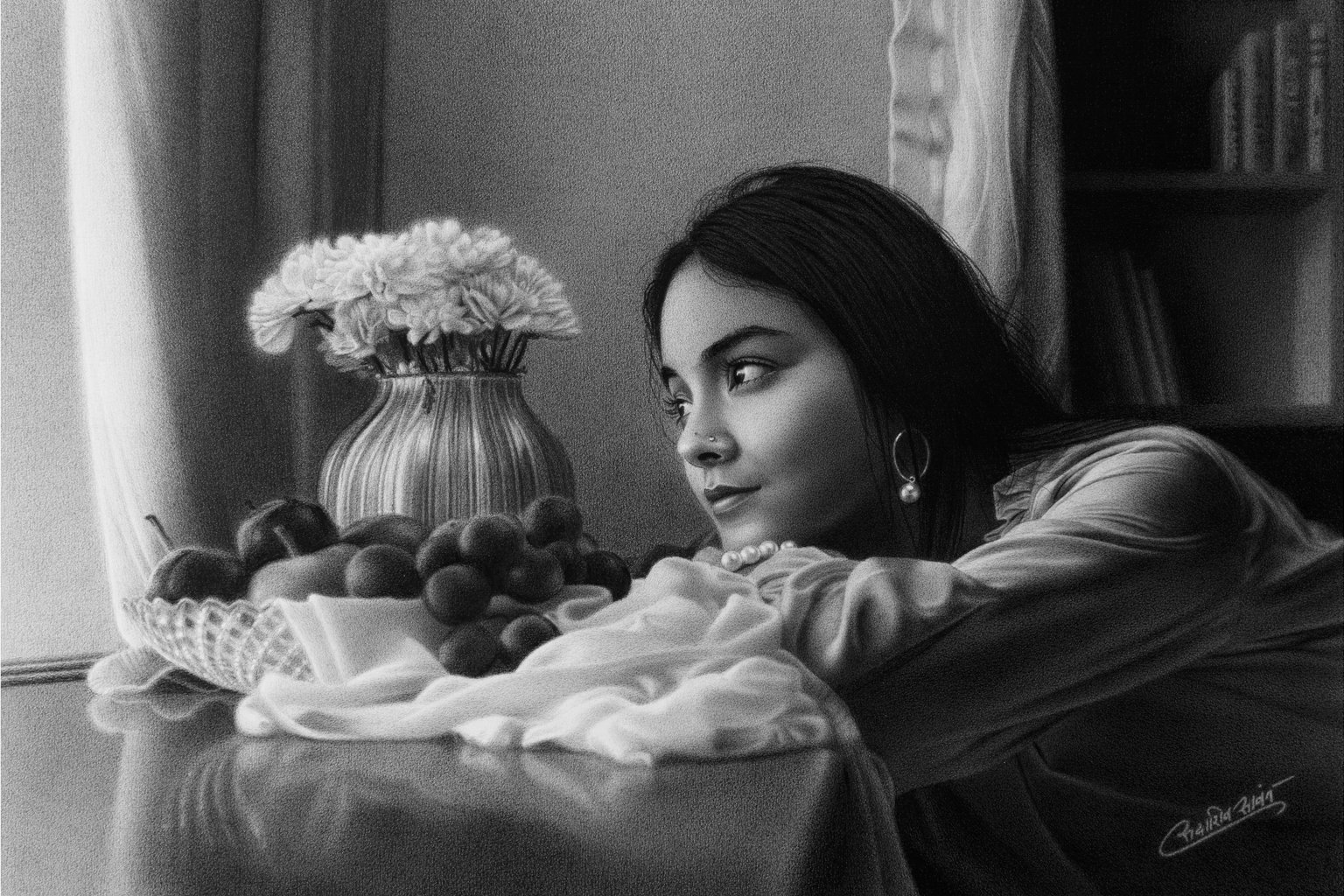
A genre once treated mainly as a technical curiosity is now part of a wider collector shift toward visibly handmade work.
I’m writing this as someone working inside that market, not observing it from outside. Here is what the numbers and the market actually show.
The Shape of the Market in 2026
After two contracting years, the global art market returned to growth in 2025. Sales rose 4% to an estimated $59.6 billion.
The recovery was uneven. Public auction sales rose 9% to $20.7 billion, while dealer sales grew 2% to $34.8 billion. Private sales declined slightly.
The market is still below its 2022 peak of $68.1 billion. It is also smaller than it was a decade ago.
Geographically, the old order remains strong. The US accounted for 44% of global sales by value, followed by the UK at 18%, China at 14%, and France at 8%.
For artists working in graphite, two other numbers matter more.
Traditional media remain dominant. Paintings, sculpture, and works on paper made up 85% of fine art dealers’ sales value. Dealers also reported that collectors were favouring established forms during a period of market uncertainty.
Digital, film, and video art together accounted for around 1%.
The message is clear. Much of the money remains in objects made by hand.
Collectors Are Looking Further
Collectors are also becoming more open to discovering new artists.
High-net-worth collectors put an average of 20% of their wealth into art in 2025. This was up from 15% the year before.
For ultra-high-net-worth individuals with more than $50 million in assets, the figure reached 28%.
More importantly, 66% of HNW collectors bought work by an artist they had only recently discovered. In 2022, that figure was 43%.
That is the number I would underline.
Two-thirds of wealthy collectors are actively buying artists they did not previously know. Discovery is not a closed door.
Specialist Hyperrealism Galleries
There are not many specialist hyperrealism galleries. That is precisely why they matter.
London’s Plus One Gallery has been an important institution for the genre since 2001. It focuses entirely on British and international contemporary hyperrealism.
The gallery has represented artists including Paul Cadden, Pedro Campos, and Young-Sung Kim. It also runs a full programme throughout the year.
The gallery has published three books on the field, including Exactitude with Thames & Hudson.
Barcelona’s European Museum of Modern Art, or MEAM, plays a similar institutional role in Europe. It holds contemporary realist work in its permanent collection.
Price expectations at this level are worth understanding.
Paul Cadden’s pencil work has reached prices of up to £20,000 through London galleries. The auction ceiling for contemporary graphite drawing is considerably higher.
American artist Woodrow Blagg’s large-scale graphite work Bull Rush was estimated at $20,000–40,000. It later sold for $168,000 at the Jackson Hole Art Auction.
The practical takeaway is simple.
Specialist galleries are few and selective. They build artist rosters over the long term.
They are not mainly a volume channel. They are a credibility channel.
The Competition-to-Gallery Pipeline
For contemporary realism, one of the most important routes runs through the International ARC Salon.
The combined 17th and 18th Salons received more than 8,500 artworks from 87 countries. They offered more than $130,000 in cash awards.
Drawing also has its own competition category.
Around 100 selected works were exhibited at Sotheby’s New York on Madison Avenue in July 2026. Of these, 46 were offered in a benefit auction hosted on sothebys.com.
The competition also creates a gallery pathway.
Rehs Contemporary Galleries in New York selects a shortlist of 15 to 30 finalists. It then commissions new work from a smaller group for a dedicated gallery show.
This is the part artists should understand.
The Salon is not only about winning a prize. It can lead to a Sotheby’s exhibition, a New York gallery opportunity, and editorial attention from publications such as Fine Art Connoisseur.
For an artist without blue-chip gallery representation, this is one of the few structured paths into serious collector view.
Art Fairs and the Gulf Shift
Art fairs now play a major role in collector purchasing.
In 2025, 58% of HNW collectors bought art at an art fair. In addition, 96% planned to attend art events in 2026.
But the fair map changed in 2026.
The Gulf became one of the most important developments for contemporary art.
Art Basel Qatar
Art Basel Qatar held its inaugural edition in Doha in February 2026.
The fair included 87 galleries from 31 countries. It attracted more than 17,000 visitors, including representatives from more than 85 museums and foundations.
The most important detail was not simply its size.
Nearly half of the private collectors and patrons came from the MENASA region. Dealers reported strong interest from Emirati, Saudi, and Qatari buyers.
American collectors were notably less visible.
European advisors also described clients who were looking to build collections beyond the Western canon.
The fair used a booth-less, single-artist format. This suited buyers who preferred depth over rapid transactions.
Reported sales for smaller and medium-sized works mainly fell between $3,500 and $25,000.
Frieze Abu Dhabi
Frieze Abu Dhabi launches in November 2026 at Manarat Al Saadiyat. It takes over from the seventeen-year-old Abu Dhabi Art.
Two details about its structure are especially important.
Its selection committee includes Amrita Jhaveri of Jhaveri Contemporary in Mumbai and Sandhini Poddar of the Guggenheim Abu Dhabi project.
The inaugural edition also invites applications featuring artists from West Asia, North Africa, and South Asia.
Younger galleries can receive bursaries of up to 30%.
South Asian art is therefore not an afterthought. It is part of the fair’s founding brief.
Art Dubai
Art Dubai remains one of the region’s busiest commercial hubs.
In 2026, it attracted galleries from 44 countries.
The underlying wealth in the region is also significant.
Christie’s recorded a 22% rise in buyer registrations from Saudi Arabia over two years. The UAE has no capital gains tax on art.
Saudi Arabia has committed more than $21.6 billion to cultural projects since the launch of Vision 2030.
Sovereign money has also moved directly into the art trade. ADQ took a $1 billion minority stake in Sotheby’s.
Why the Gulf Matters for Hyperrealism
The Gulf matters because its collector base is changing.
The emerging Gulf collector is younger, internationally educated, and interested in identity, heritage, and legacy.
This can create an opening for technically accomplished and culturally rooted figurative work.
Hyperrealism can communicate its technical skill immediately. Narrative and figurative work can also connect clearly with collectors interested in identity and heritage.
For an artist based in Mumbai, the Gulf is also geographically close.
It is a three-hour flight rather than a sixteen-hour one.
That makes the region particularly relevant for South Asian artists looking to enter an international market.
India’s Growing Art Market
India’s own art market has also become substantial.
India Art Fair 2026 brought together a record 135 exhibitors. This included 94 galleries and 24 institutions.
Established galleries showed work priced from $6,000 to $600,000.
Around 60–80% of buyers are now Indian or India-based. This gives the market some protection from external shocks.
GST on fine art also dropped from 12% to 5% in September 2025.
In April 2026, Raja Ravi Varma’s Yashoda and Krishna sold for approximately $17.9 million. This became an all-time record for any South Asian painting.
There is an important caveat.
Institutional patronage in India remains narrow. Record prices are still concentrated around a small group of modern masters.
India is a real market for contemporary realism, but it is not yet a deep one.
Direct Sales and the Artist Studio
Online art sales fell to $9.2 billion in 2025. This was their lowest level since 2019.
Online sales represented around 15% of total market value.
This does not mean online is no longer important.
Online is where many collectors research. In-person is where many high-value transactions happen.
The most interesting behavioural shift is the growth of artist studio visits.
Average studio visits rose from five per collector in 2019 to eight planned visits in 2025.
Collectors want to meet artists and see how their work is made.
For a practice built around visible and sustained hand-work, this creates a strong selling environment.
What This Means for Realist Artists
Five important points follow from the market.
Traditional Media Remain Strong
Traditional media are not a liability.
During market uncertainty, collectors moved toward paintings, sculpture, and works on paper. These categories account for 85% of dealer sales value.
Discovery Is Open
Two-thirds of HNW collectors bought work by an artist they had recently discovered.
That number was 43% in 2022.
The direction is clear. New artists can still enter the collector market.
Competitions Need Real Infrastructure
Competitions with strong industry connections can matter more than competitions offering large prizes.
The ARC Salon is important because it can lead to a Sotheby’s exhibition and a New York gallery pipeline.
The Gulf Is a Major Opportunity
The Gulf is becoming increasingly important for South Asian artists.
Both major fair operators have established a presence in the region. Frieze Abu Dhabi has also included South Asian practice in its founding brief.
Your Studio Can Be a Sales Channel
Studio visits are one of the fastest-growing forms of collector engagement.
For artists working in hyperrealism, this is especially valuable. Collectors can see the time, skill, and hand-work behind the finished piece.
Where Can You Buy Hyperrealistic Art in 2026?
There are four main routes.
First, specialist galleries such as Plus One Gallery in London.
Second, curated realism exhibitions such as the ARC Salon show at Sotheby’s New York.
Third, regional art fairs. The Gulf circuit, including Art Basel Qatar, Frieze Abu Dhabi, and Art Dubai, is becoming increasingly important.
Fourth, artists’ studios.
For many collectors, the studio provides the most direct way to understand both the artist and the work.
What Does Hyperrealistic Art Sell For?
Prices vary widely.
Established pencil hyperrealists have sold through London galleries for up to £20,000.
The auction record for a contemporary graphite drawing stands at $168,000.
At Gulf fairs, mid-market works have largely traded in the $3,500–$25,000 range.
These figures show the wide range of prices in the market. They should not be treated as a guarantee of future value.
Is Hyperrealism a Good Area for New Collectors?
Hyperrealism has genuine institutional infrastructure.
It has major international competitions, juried exhibitions, dedicated galleries, and museum collections.
At the same time, it remains less crowded than some areas of blue-chip contemporary art.
The quality of an individual artwork still matters more than the category itself.
Nothing here should be treated as investment advice.
Why Is the Gulf Important for Contemporary Realism?
The Gulf is becoming important because several trends are happening at the same time.
The region has a younger collector base, strong cultural investment, and growing international art infrastructure.
The UAE also has no capital gains tax on art.
Two major fairs are now strengthening the region’s role in the global art market. One of them specifically highlights artists from South Asia.
For contemporary realist artists, this creates a market that deserves serious attention.
You can view current work in the portfolio, or get in touch to arrange a studio visit or discuss an acquisition.