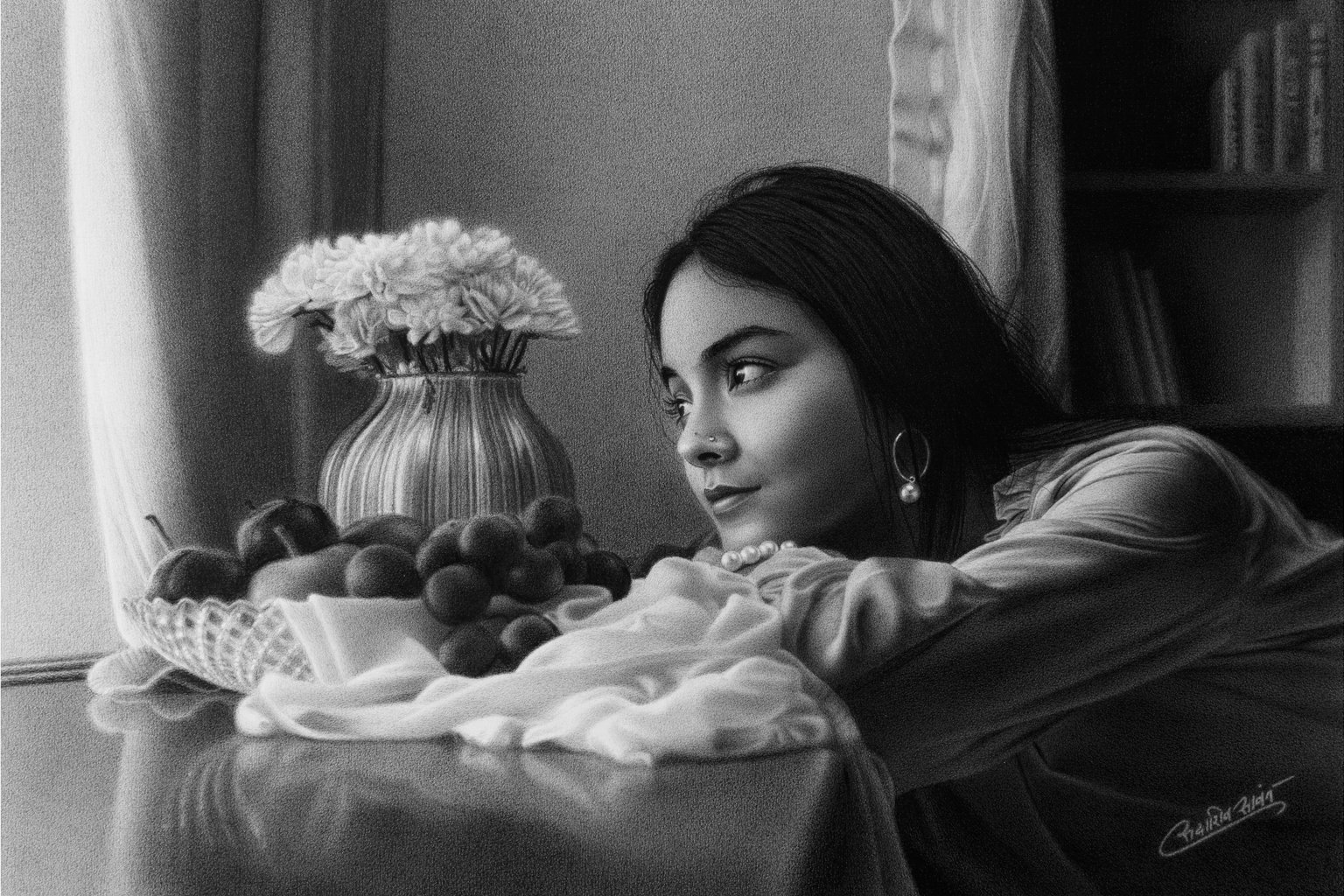
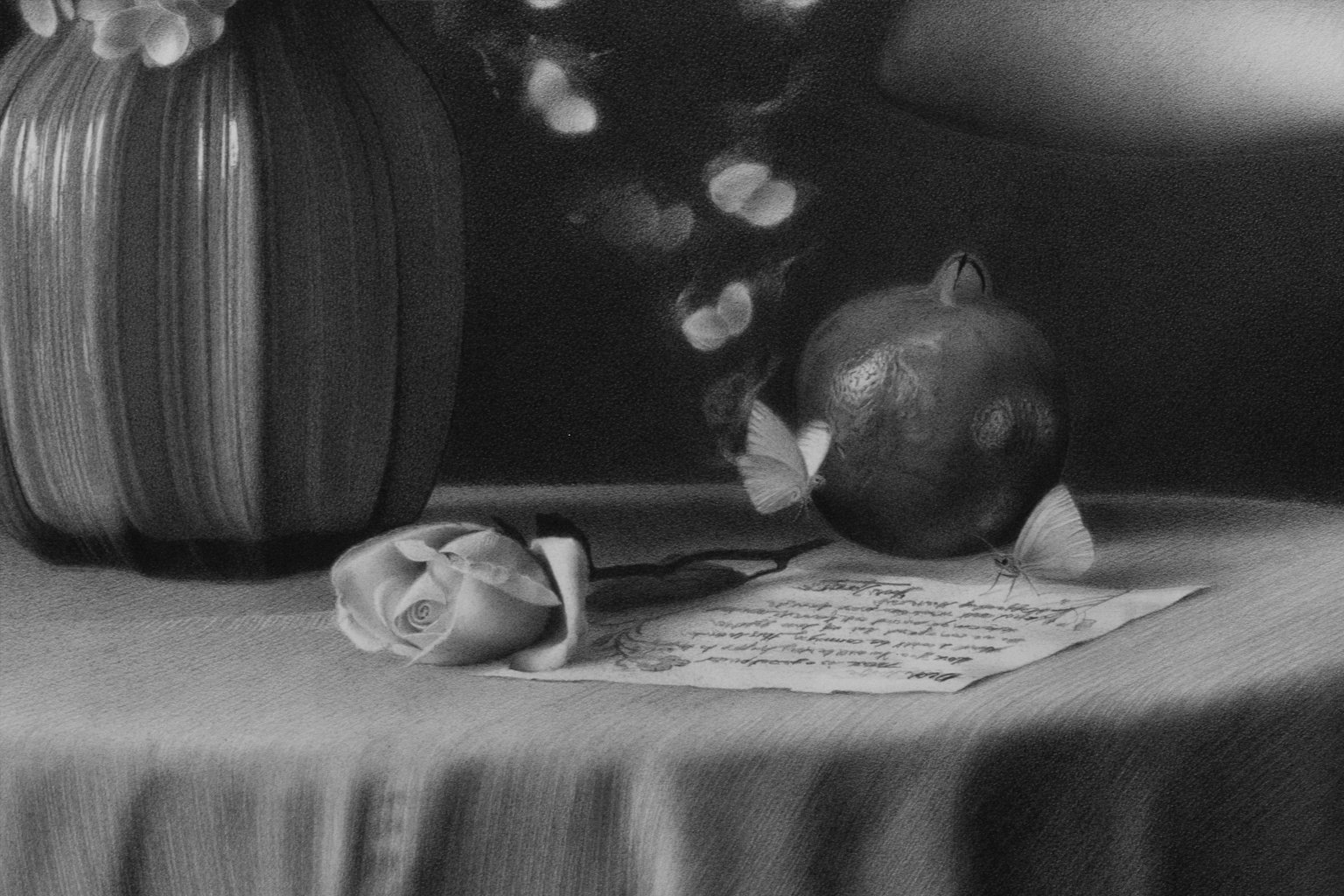
A few months ago someone left a comment under a portrait I had just finished. Four words: “AI can do this.”
I did not delete it. Instead I sat with it for a while, because the honest answer is that a machine can now produce an image that, on a phone screen, looks close enough. That drawing took me a little over 200 hours across three months. On a 6-inch screen, at arm’s length, the difference between those 200 hours and 20 seconds is almost invisible.
Almost.
That word is where my entire argument lives. After fifteen years of working in graphite, I have come to believe that hand-drawn realism does not matter less as image generation gets better. It matters more, for reasons that have very little to do with nostalgia and a lot to do with how value actually works.
Images became infinite. Attention did not.
Before 2022, a convincing image of something that does not exist required either a camera, a crew, or a person with a trained hand. All three moved slowly. Each one cost something real.
That bottleneck is gone. Anyone can generate a photoreal image of a woman in a rain-soaked street in Kyoto, then spin out forty more variations of her before finishing a cup of tea.
When something becomes infinite, its price falls to zero. That is not a complaint, it is just arithmetic. What people are quietly discovering is that the scarce thing was never the image. The scarce thing was the human decision behind it, and the hours a person was willing to burn to make it exist.
So the question for an artist is no longer “can I make a realistic image.” It is “what remains rare.” Hand-drawn realism is rare in a very literal, boring, unglamorous sense: it takes a specific person a specific and unrecoverable amount of their life.
A drawing is a record, not just a picture
Here is something you notice only when you draw for long enough.
A finished graphite work is not a flat picture. It is a physical record of every decision I made while looking at a face. Where I slowed down. The moment I lifted graphite off with a kneaded eraser because the shadow under the jaw read too heavy. One stretch of paper where the tooth fought back and I let it, because that resistance gave me the exact grain I wanted in a beard.
I work almost entirely with a single grade of graphite, 8B, which most people would call an unnecessarily hard constraint. Most artists reach for a pencil that soft only in the darkest passages. I use one for everything, light values included, which forces me to build tone through pressure, angle, and layering rather than by switching tools. Tilt the finished drawing under a lamp and you can see the result: a low, uneven sheen where I burnished the graphite, a matte surface where I left it open.
An AI image holds no such record. It carries no pressure, no hesitation, no recovery from a mistake at hour 90. The thing arrives fully formed, with no history behind it. That absence is exactly what makes it cheap, and exactly what makes it feel slightly hollow when you stand in front of a print of it.
Hand-drawn realism carries evidence that someone spent a portion of their life on it. People feel that even when they cannot articulate it.
Why collectors are moving toward hand-made work, not away from it
I speak with buyers regularly, and the shift over the last two years has been clear. The flood of synthetic imagery has not reduced interest in original drawing. It has sharpened it.
Three reasons come up again and again:
There is only one. A generated image is a file. Anyone can copy it perfectly, forever. A drawing is an object on a sheet of paper that exists in one place in the world. Ownership means something different when nobody can duplicate the thing.
The surface shows its own working. Hold a drawing under raking light and the layers reveal themselves in the order I laid them down. Nothing about that sequence can be faked afterwards. It is a document that verifies itself.
It represents a limit. I can complete perhaps four to six major works in a year. That is not a marketing constraint, it is the actual ceiling of what one pair of hands can produce at this level of finish. Scarcity that comes from a real physical limit behaves very differently over the long run from scarcity a marketing team invents.
None of this argues that hand-drawn realism is morally superior. It argues about what holds value when the supply of everything else goes vertical.
Hyperrealism was never about copying
A persistent misunderstanding says that a hyperrealist is a human photocopier, and that AI has therefore made us redundant. If that were true, the redundancy would have arrived with the camera in 1839, not with diffusion models in 2022.
What actually happens when I draw from reference is closer to editing than copying. A photograph flattens. It crushes shadow detail, blows out highlights, and gives equal weight to everything in the frame. My job is to decide what a viewer’s eye should do: which edge stays sharp, which one dissolves, where I push the light a quarter-value warmer in feeling even though graphite carries no colour at all.
Those choices come from having looked at thousands of faces and understanding what the skin over a cheekbone does when light rakes across it at a low angle. No prompt retrieves that understanding. You build it slowly, by failing at it repeatedly.
A generated image optimises for plausibility. A drawing optimises for a particular person’s intention. Those are genuinely different products, and over time I think the market will price them differently.
I am not anti-AI, and pretending otherwise would be dishonest
I use these tools. They sort reference material, draft correspondence, and help me think through composition options before I commit to a sheet. Refusing to touch a useful tool in order to look pure is a strange way to spend a career.
What I do not do is let a machine make the marks. The line between assistance and authorship is not blurry to me at all: if the graphite went down because my hand put it there, it is my drawing. If it did not, it is not.
Artists who take a clear, honest position on this will do fine. The ones who stay vague about it will struggle, because trust is now the whole game. Buyers actively look for work whose origin they can verify.
How to tell hand-drawn realism from a generated image
If you are buying, this is worth knowing. A few practical checks:
Tilt the work under raking light and look from the side. Graphite throws a metallic sheen that shifts depending on how heavily the artist burnished each area. A print behaves uniformly across its whole surface.
Study the highlights. In real graphite drawing, the artist usually cuts them back out of a dark field, and the edges of those lifts carry a softness no printer reproduces.
Look at the paper. Cotton rag has visible tooth, and graphite sits in and around it unevenly. Ask which paper the artist used, because any working artist answers that instantly.
Request the process documentation. I photograph my work at stages throughout, and most serious realist artists now do the same. It has quietly become part of provenance.
Finally, ask about the timeline. A real answer sounds specific and slightly tedious, because the work itself is specific and slightly tedious.
What the hours are actually for
I keep returning to that comment. AI can do this.
It can produce something that resembles the drawing. It cannot produce the drawing itself, because the drawing includes three months in which one person looked at a single face and very little else, and that attention is the content, not just the method.
When images cost nothing, the ones that cost a great deal become legible in a way they were not before. That is the strange gift the last few years have handed to those of us who work by hand. For a long time, realism had to justify itself against photography. Now it only has to be what it already is: slow, singular, the work of one person, and impossible to generate.
I am in my studio in Mumbai most days, with one pencil and a sheet of paper, doing something that has not fundamentally changed in centuries. It has never felt more relevant.
I work in hyperrealistic graphite from my studio in Mumbai, with recent selections including the ARC Salon and the Chianciano Biennale 2026. To view available original works or discuss a commission, please get in touch.